Loving Touch is Important at Every Age!

Recently I visited with our twenty something son. As he walked in, he gave me a big hug and I kissed him on the cheek. As I was preparing for my parenting groups this week I was thinking about that moment. The hug and kiss of my son, who is definitely a young man now, was as sweet ( albeit a bit more scruffy and I was on my tip toes) as the snuggle I would have with him as a baby. Loving touch with your child is at the center of a parent and child bond. The connection between child and parent through touch is undeniable. I am a firm believer in the importance of touch and our children….from birth, to toddler years, preschool, school age, and yes even in the awkward teens. Continuing the physical hugs and kisses are important for your child and you.
Snuggles and touches are natural for most parents with an infant. Infant massage has been proven to provide many benefits for babies. Routine loving massage can help an infant
- Gain weight
- Calm
- Improve sleep
- Improve their latch for nursing
- Increase bonding
- Improve neurological development
- Improve their immune system
- Decrease teething pain
- Decrease congestion
- Learn body awareness
- Learn that touch is a loving expression
- and the list goes on…..
Getting started…
- Turn off th TV, cell phone and other distractions. This is time to concentrate on your baby alone.
- Warm up the room and your hands.
- Lie your baby on his/her back a warm towel or blanket.
- Use a vegetable based oil. (if you could eat it, then it is OK)
- Make sure you are calm.
- Make eye contact with your baby.
- Ask permission to touch, show your baby your hands.
- Lay your hands on your child lovingly. Often babies prefer touch on legs and feet first.
- Use light gentle touch, but not a tickle touch.
- Move from the center out…upper thigh to foot.
- Give equal treatment to both sides of the body!
- Movements should be slow and relaxed…like a lullaby. Sing while you do it! 🙂
- Start with a short session and watch your baby’s cues. If your baby wiggles away, fusses, looks away, then stop and try again at another time. As your baby becomes accustomed to massage, the length of time may increase. You don’t have to massage your baby’s whole body, just the parts that he or she enjoys!
Technique:
- Make eye contact with your baby and sing or talk to him–or play music.
- Breath, relax yourself
- Hold one foot in one hand and use the other hand to milk the leg. Squeeze thigh to foot, this is the “milking” motion.
- Roll leg between hands from thigh to ankle, like you are rolling dough or clay.
- Finish with long strokes from thigh to foot.
- Press the sole of your baby’s foot with your thumbs. Massage each toe. Play “this little piggy”.
- Repeat on other leg.
- Follow same process of milking, rolling, and stroking on the arms.
- Press the palm of your baby’s hand with your thumbs. Massage each finger.
- Slide your palm and fingers in a circular motion from the ribs downward. Then move clockwise around the tummy. Smooth the chest like pages in a book.
- If you have used massage for a while, some babies will allow you to massage their face. Massage face with light fingertips stroking across the forehead from the center to the sides. Massage tears ducts. Move down nose and on the sides. Use a circular motion from the temples down the side of the face.
- Massage shoulders and use long strokes down the back and on the bottom.
Remember…the intent of your touch is much more important than your technique! Just relax and enjoy!!
I Love You massage for colic or gas
- Trace the letter “I” on the right side of your baby’s tummy. Start just under his ribs and move down to your baby’s hip.
- Now stroke from left to right on your baby’s lower tummy making the long part of the letter “L”.
- Make a short downward stroke on the right side of your baby’s tummy making the short to complete the “L”.
- Complete the “I love you” by making an upside down “U” starting at your baby’s left hip and circling along the top of the tummy and down the right side.
- Continue these strokes to help calm a gassy tummy.
Massage can continue to some degree all the way through childhood. There were nights that I sat on the side of my children’s bed and massaged an aching tummy or head, and I have massaged sore muscles after a big game or meet. The continued touch with your child will keep you connected in many ways. There were certainly times when I hugged my children in those teen years and I got an eye roll too…but because of those continued “loving touches” through the years, the hugs in the stands of a high school football games, college track meets, quick weekend visits at school, and now when our “adult” (they will always be my kids) kids visit those hugs and kisses continue. Don’t underestimate the value of teaching your child the benefits of touch as an expression of love.
Check out your local hospital for classes on infant massage.
Take a breath, enjoy the joyful moments of each day, and remember you don’t have to be perfect to be the perfect parent.
Cindy

Baby Sign…why?
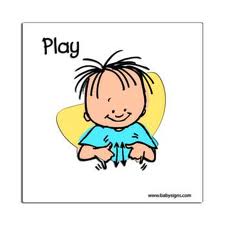
Signing with your child opens up his world to communication!
Picture this: your sweet 1-year-old child is lying on the floor screaming. You ask what this sweet child wants, and the screaming escalates. You then run around the room holding items up…”Do you want your milk?” “Oh I bet you want your paci!” “You want to read your book?”….and the game continues. Waiting for your child to be able to express a want or need can feel like an eternity, especially when you have a 1-year-old lying on the floor in a meltdown. It is a frustrating experience for you and your child when your child is not able to communicate a need or something he or she is excited about. In recent years many parents have begun signing with their children. Some ask, “Is this just another passing fad or another attempt to make our children “super kids”?” Others ask, “Won’t this delay verbal speech?”
The fact is, parents have used “sign language” for years with their babies. Babies need to express needs and parents want desperately to find out what their child wants or needs. So, often we will see gestures, whines, and partial syllables that mean something to a parent.
We know that children develop the fine motor muscles in their hands before they develop those needed for speech. Most babies develop their own “signs” to communicate. Games like “Patty Cake”, “How Big is Baby?”, “Waving bye-bye” and other finger plays show that babies can communicate before they are actually verbal. Children follow directions and understand verbal commands before they are able to verbally communicate also. So, it seems natural that American Sign Language (ASL) could allow a child to express needs, emotions, fears and memories without using words.
Imagine the decrease in frustration, the increase in interaction, and how much fun it would be if your child could express wants, needs, and excitement to you about all the new discoveries in his toddler life. Often children that have signed also develop verbal speech earlier. Kids that sign understand that a symbol, the sign, actually means something, a gesture connects to an item. These connections help link words to things too, and even the written word to the verbal word. It is all about connections or links.
So besides decreasing your child’s frustration and helping your sanity….here are a few more advantages to Baby Sign:
- A child who signs can communicate needs at an early age.
- A child who signs learns the art of conversation.
- A child who signs will have an understanding of language at an early age.
- A child who signs may learn to speak verbally at an earlier age.
- A child who signs may have an above average ability to learn a second language. Learning ASL develops that portion of the brain that learns language!
- A child who signs may have an increased love of books. Think about the interactive reading that can occur with both of you signing as you read!
- A child who signs often will be more expressive later using gestures.
- A child who signs feel empowered!
- A parent who signs will have a lower frustration level.
- A parent who signs may have an increase in bonding because of better communication.
- A parent who signs may experience a higher level of satisfaction in parenting.
So there are many reasons to start signing with your child. If your child is between 6 months and 36 months, it is the perfect time to introduce the concept. There are few things more exciting for a parent and a child than the realization that a child has linked a sign or a word to a meaning and can communicate. Warm up those hands, and get started “talking” with your baby!
Take a breath, enjoy the joyful moments of each day, and remember you don’t have to be perfect to be the perfect parent.
Cindy

Want dry nights ahead? Try going without the Pull Up!

Help your child develop nighttime dryness…go without the Pull Up!
Your little one is rocking with daytime potty training but struggling with being dry at night? Are you tired of changing sheets several times a week, or are you still buying Pull Ups?
Bed wetting is very common in children who are potty trained during the day, and often gets better as the child matures. Often bed wetting is familial, meaning Mom or Dad were bed-wetters as children. My advice for bed wetting is similar to my advice for potty training. Be patient and get rid of the Pull Ups as soon as you see your child is capable of being dry for long periods during naps or occasionally at night. Pull Ups are convenient, but just like daytime potty training; they may slow down the process for nighttime dryness if your child is ready. A child must be given the opportunity to try to stay dry at night…give up the Pull Up and just give it a try! Nighttime dryness happens when a child wakes because he or she feels the wetness of the start of an accident…that just does not happen when wearing a Pull Up. A child must form a connection from the feeling of a full bladder and their brain and if your child wears a Pull Up; it is more difficult to form this connection.
Nighttime dryness is a big step for children. Bed wetting is seen in about 40% of 3 years olds, 20% of 5 year olds and about 10% of 6 year olds. It is very common! How can parents help their children move out of a Pull Up to dry nights?
- You must try to have nights from time to time without the Pull Up, especially if you are seeing that there are mornings that your child is dry. Don’t assume that your child cannot be dry at night…give it a try!
- Try limiting fluids in the evening and taking your child to the bathroom before you head to bed.
- Make sure there is a night-light and a bathroom light so your child can see where to go if the urge to pee hits!
- Be sure that your child is getting adequate sleep. An overly tired child will often sleep too deep to wake from a full bladder.
- Never shame your child for wetting the bed. “Accidents happen, you will be dry soon.” It is hard when you are up changing sheets at 2 AM, but do not let your child feel your disappointment or frustration. This will only increase your child’s anxiety.
- Tell your child if Mom or Dad was a bed wetter. This provides your child support and the knowledge that it is not forever!
- Celebrate any success…a dry morning, a dryer morning (less pee), or your child getting up to potty in the middle of the night.
- If your child becomes frustrated, go back to the Pull Ups for a few weeks and then try again later. Sometimes just a few weeks will result in that brain bladder connection developing. Don’t give up, just take a break!
- If your child is older and still wetting, there is some success in trying an alarm system for the bed that goes off when there is the start of any wetness. This has been helpful for older children who are very deep sleepers.
- If your child is older than age 6 and still having problems, it is best to address the issue with your pediatrician to explore other possible options.
Any suggestions from you parents that have children with dry nights? Share!
Take a breath, enjoy the joyful moments of each day, and remember you don’t have to be perfect to be the perfect parent.
Cindy
Potty pitfalls

So, the potty training process has started! Remember the mantra, “Two steps forward one step back!” Potty training is a huge task for a toddler and a parent. Sometimes you have a great couple of days, when you both are concentrating on the process, and then there is a bit of a back slide when you both relax a bit. This is very common. There are a few other “pitfalls” that are often seen as children and parents tackle the potty training process:
Potty Pitfalls
1. Fears
- Use of a small potty chair helps with fears of the adult toilet. Begin with sitting on the potty fully clothed and progress to sitting without clothes. Let your child’s favorite doll or stuffed animal “potty” too!
- Fear of flushing the potty is common, do not force the child to flush or shut the lid when flushing. Automatic flushing public toilets can be scary too. Cover the sensor with a post it note to prevent it flushing while your child is sitting!
- If your child is a real “pleaser” or is afraid to disappoint be sure you don’t sound upset or exasperated with the process. When there is an accident say “Oops there it went, a little accident. Next time you will go in the potty. We’ll try again.” When he does go, congratulate but don’t be overly excited as this may increase the pressure to be successful again resulting in a child who is afraid to disappoint.
- Fear of pooping. Some children potty train easily with “peeing” but struggle with the “pooping”. It causes fear in some toddlers to actually sit and poop without a diaper. Do not force the issue in the beginning…start slow. Some toddlers may have to progress from “pooping” just standing in the bathroom for a few days, to “pooping” sitting on the potty chair in the diaper a few days, to “pooping” without the diaper on the potty chair.
2. Holding stool.
- This happens sometimes when a toddler is afraid to poop. This results in the stool becoming hard and painful which begins a cycle of holding and constipation.
- Try to soften stool with diet by increasing fluids, fruits and vegetables or occasionally with medications like Miralax (speak to your child’s doctor before use).
- Back off of potty training and go back to diapers until your toddler no longer is constipated or having painful stools. This cycle needs to be broken for at least 2 weeks before you begin again.
- You may have to let your child poop in their diaper standing in the bathroom, then poop sitting on the potty in the diaper and finally progress to even cutting a hole in the diaper and allowing the child to poop into the potty while wearing the diaper. This may help with the fear of pooping in the potty.
- Talking with your doctor is a good idea.
3. NO!
- A toddler’s favorite response is “NO”! This stage fades at about age 3. Battling with a toddler is not productive and you NEVER win! The attention you give during a battle reinforces the behavior. You cannot force a child to “poop” or ” pee”. Make it clear to your toddler that potty training is for your child not you. The fact is that children all want to progress and develop. Your child will eventually want to use the toilet.
- Do not ask a yes or no question unless you are OK with the answer NO. Tell your toddler “It is potty time!” Do not say “Do you have to go potty?” This gives a choice that may not be a true choice and will result in a battle or tantrum!
4. Accidents
Accidents will happen!!!
- Stay calm. Toddlers do not have accidents to irritate you! Toddlers age 3 and younger will not try to have an accident to upset you!
- Remind your child to slow down, sit a bit longer and completely empty his bladder. This will prevent accidents later.
- Make sure you remind your child to potty. Children get involved in play and forget!
- The older child (after age 3) can help clean up the accident. Do this matter-of-factly–not like it is a punishment.
5. Night time Control
- Nighttime training will come later. 75% of 5 year olds are trained at night with minimal accidents. Children who do continue to wet the bed after 5 often have parents who had a history of bedwetting. There should be no punishment involved with bedwetting. Children can continue to wear “sleeping diapers or pants” until later. You can talk to your doctor about when further treatment might be needed.
Your child will be successful! You both will be proud. This is just one of the many challenges you and your child will meet together!
Take a breath, enjoy the joyful moments of each day, and remember you don’t have to be perfect to be the perfect parent.
Cindy
Easter egg hunts and the importance of family tradition


Easter always brought out the hats, gloves, and even with my husband’s protest….plaid shorts and sweaters for Connor! The dress will be a little different this weekend, I am sure! 🙂
I am so very blessed to have 3 of our 4 children, our wonderful son in law and our 2 perfect grandsons home this coming weekend to celebrate Easter. We will miss our oldest daughter! It is easy to plan the weekend, because it is almost exactly the same every Easter! The girls will not be wearing white gloves and Easter bonnets like they did when they were young, but all will be dressed up for church Easter Sunday morning. The eggs will be colored Saturday evening, the Easter dinner menu will include the traditional ham, “Easter cole slaw”, and other favorites, and of course there will be an egg hunt. As the children have gotten older, of course there are a few changes…the egg hunt now includes eggs filled with quarters or maybe a few gift certificates and a few “golden eggs” with a little extra cash for pizza or a movie. There is a real feeling of serious business as they head out for the eggs! The sweet little egg hunt they had when they were young with their cousins has become a race to the finish with winning in mind. The last few years, I always wondered what our neighbors think when they see grown adults with Easter baskets looking for those golden eggs. Things will change a bit again this year with 2 grandsons who know how to hunt for eggs, but the basics of the celebration will always remain the same….because as our kids say, “That is how we always do it!”
If we are smart we listen to our children when they say “That is how we always do it!” even when we have only done it that way one other time. Your child is not just talking about the good time he had, but the fact that it meant something to him and he thinks to you too. One of my favorite quotes is from the book The Little Prince by Antoine de Saint-Exupéry, “We live not by things, but the meaning of things.” It is not what you do or eat that is important, it is the meaning and feeling that comes with what you are doing that is so important to your child.
Creating your own special rituals now and faithfully repeating them throughout your child’s life will provide your child with a sense of security, stability, belonging and pride in his family. It is never too early to start your own family traditions.
Four reasons tradition is important to a family:
1. Traditions helps make life predictable. Rituals that are followed daily, weekly, and yearly such as family dinners, nightly stories, spring picnics, holiday songs etc. helps make children feel secure. Their world is often unpredictable—keeping things predictable at home gives security.
2. Traditions give families a time to connect. Sometimes we can feel unconnected when we get busy. Family meals, stories, game nights etc. help us reconnect and start talking. Soon we know what is going on in our children’s lives.
3. Family traditions teach children what their family values are. Service work, religious ceremonies, concern for the environment and many other values can be established through family traditions and activities. These are values that when they are reinforced with traditional activities, your child will bring with him to adulthood.
4. Tradition forms family identity. Build a family group for your child to feel connected to and this will often prevent them from trying to find other less suitable groups to identify with. A child’s family is a huge piece of their identity.
Traditions can be very simple…it is the act of repeating them, allowing them to change with your family’s “season in life” and keeping them fun that is the key. If something is not fun anymore, then let it go!
Don’t get hung up on creating the prefect rituals, let them happen naturally based on what your family enjoys. Many traditions just happen. The wonderful thing about becoming your own family is that you get to create your own traditions from scratch. Some you will come up with on your own, some you will borrow, and some you will discard from your past, but the traditions will become part of who your family is.
Some suggestions to try that might be fun:
1. The Easter Egg hunt…definitely a tradition.
- Hide a combination of plastic filled eggs and hard boiled
- Hide baskets
- Fill plastic eggs with clues to a bigger prize
- Use “bunny prints” to guide your child to his or her basket
- Put out carrots for the Easter Bunny
- Purchase a “special” basket for each of your children to be re-used each year
- Hard boil the eggs, let them cool slightly and let the kids “color” on them with crayons. The heat of the egg will melt the crayon just enough to make it easier.
- Use stickers to decorate the eggs until you are ready to tackle egg dye.
- Have an egg decorating contest
- Glitter eggs…roll eggs is glue and glitter
- Use fine tip markers to decorate detailed eggs
- Try marbling eggs by adding a little vegetable oil to the dye you are using
- Tear up different colored tissue paper and glue it on the eggs for a stain glass window look
- Traditionally at the end of a Lenten fast, many families indulge in sweets, find an Easter dessert that you can make together.
- Find a menu that everyone enjoys, and make it your own! Spring marks the start of lots of fresh local foods. I can’t wait for the fresh new asparagus for our Easter dinner!
Take a breath, enjoy the joyful moments of each day, and remember you don’t have to be perfect to be the perfect parent.
Cindy
Should you worry about heavy metal contaminants in your baby’s food?
By: Cindy Love MSN CPNP
The introduction of solid foods is often an exciting time for babies and parents. Is there anything cuter than your baby sitting in a high chair with food spread from ear to ear exploring the new taste of sweet potatoes? Having access to healthy food is key to a child’s proper growth and development. With the recent reporting of the presence of heavy metals in most commercial baby foods, parents are adding another worry to their parenting worry list. Toxic metals like lead, arsenic and mercury are often found in soil and water. So, food grown in this soil will take up these contaminants. Additional contamination can occur during manufacturing and packaging of processed foods. Children’s developing brains are more likely affected by these heavy metals which can affect learning and behavior. Parents need to remember many things influence a child’s brain development and this heavy metal exposure is just one of them. However, any way that we can limit our child’s exposure to these contaminants will be a benefit.
The American Academy of Pediatrics states that the low level of heavy metals found in baby foods are most likely a small part of a child’s overall exposure to heavy metals. We as parents need to work on limiting this exposure in all aspects of our children’s lives. So what can we do to prevent the exposure?
- Buy organic? Buying organic does not prevent heavy metal exposure. Some of the baby foods tested that were labeled organic actually had some of the higher levels. Organic food will limit pesticide and chemical exposure but not heavy metal exposure.
- Make your own baby food. Making your own baby food will help limit any heavy metal contamination from the manufacturing and packaging process; but this will not prevent the contamination of the food from the soil and water.
- Limit your child’s rice intake. Arsenic exposure is seen in diets high in rice content. Rice cereal often is one of the first foods introduced to babies. Choose instead a whole grain cereal such as oatmeal, wheat, or barley. Many toddler foods/snacks such as puffs, combination meals (chicken, vegetables and rice), and teething cookies (Mum Mums which are rice rusks) are high in arsenic. Choose snacks like puffs made with other grains, cheese cubes, frozen fruit to help with teething pain, and combination meals without rice.
- Serve a variety of foods. This provides a well-balanced diet of fruits and vegetables, grains and proteins which will lower the exposure of contaminants from single food choices. Sweet potatoes and carrots have some of the highest levels of contaminants, so including many other vegetables along with sweet potatoes and carrots will lessen exposure. Wash all fruits and vegetable well in cool water before serving.
- No juice for children under age 1. Very limited juice for children over age 1 (4 to 6 oz/day). Juice, especially apple juice, has higher levels of contaminants than the whole fruit. Choose the whole fruit which has more nutrients and fiber.
- Do not use rice milk as a milk substitute for toddlers and older children. Rice milk contains significantly high levels of arsenic. If your child has dairy allergies, talk to your pediatrician for other choices!
- Serve fresh whole foods. This is always better both for nutrition and the prevention of exposure to harmful additives and heavy metals during processing and packaging.
- Serve fish that is known to be lower in mercury. These choices would include light tuna, salmon, cod, and white fish. Fish is a healthy source of protein!
- Don’t smoke or vape. A child’s second hand exposure (breathing in the smoke) or third hand exposure (clothing of a smoker/vaper) will increase exposure to cadmium and lead.
- Check older homes for lead paint. Exposure to lead through chips/peeling of lead paint is the most common way for children to develop high lead levels.
We can’t prevent 100% of a child’s exposure to these heavy metal contaminants, but we can do our best to limit the exposure. Do your best, provide whole fresh foods as often as possible, limit the amount of rice based snacks and foods, and serve a variety of foods… then relax and enjoy that sweet face covered in food grinning at you!
Take a breath, enjoy the joyful moments of each day, and remember you don’t have to be perfect to be the perfect parent.
Cindy
Additional resources:
Tips to Reduce Arsenic in Your Baby’s Diet
Heavy Metals in Baby Food and Fruit Juice: Advice for Parents from Environmental Pediatricians
5 Baby Foods with Arsenic and Lead and Safer ChoicesEverything You Need to Know About Heavy Metals and Contaminants in Baby Food
Happy and Healthy Families in 2021
The New Year often has us looking at goals and resolutions. I am not a big fan of New Year resolutions, they often set me up for failure. I am a big fan of New Year hopes. There is something about new beginnings that gives me a bit of excitement. I always liked the beginning of a new semester, the start of a new sport season, opening a new daytime planner, even the start of a new day. There are so many possibilities with new beginnings. 2021 is no exception……
My hope for all of us is a lot more happiness and health in 2021. How do we get there as a family? There are a few simple things we can do which can truly make a difference in our life and our children’s lives.
Sleep…we all need it. Without it we are less patient, more irritable, less energetic and actually less healthy. Studies show our risk for obesity and cardiac disease increases with poor sleep habits. Bedtime routines for our children and ourselves are very important. Think bath, book, bed! Good for adults too!
Cook together, eat together and don’t skip breakfast! Starting the day off right with breakfast that includes both carbohydrates and protein is important. Keeping blood sugars from crashing improves learning and behavior in both children and adults. Life is better when we aren’t “hangry”! We also know that children who help out in the kitchen are more likely to eat what is prepared and families who eat together are better connected and children are more likely to do better in school and have less behavioral problems.
Move! Exercise improves health and mood. Feel good hormones (endorphins) increase with movement. A brisk walk outdoors, a dance party in the house, playing at the playground, a quick game of basketball on the driveway or soccer in the yard makes everyone feel better. Physically tired children and adults sleep better too! It feels so good to be physically tired and not just mentally exhausted!
Unplug! Decreasing screen time can increase happiness! Put down the phone, turn off the TV, get off social media and this can result in more movement, less mindless eating, more conversation with family, and less competitive parenting/comparisons through social media. You will be more present instead of viewing the world through a screen. Get those board games out, sit and read, or simply share your day in conversation and improve the mood of your family!
Plan a little fun, be spontaneous, celebrate everything! Sometimes we need to simply plan a little fun. Do something a little out of the ordinary. Eat ice cream for dinner. Families that work fun into daily routines are happier. Why not celebrate “over the hump Wednesday” or “Fun Friday”? How can you make “Taco Tuesday” a little more fun? Keep it simple, but planning fun or a little crazy into your life can bring some welcomed stress relief and laughter into a week.
Outside everyday! Sunshine, fresh air and a little nature are all mood boosters for children and adults. There are very few days that the weather is too bad to be outside. There is no bad weather, just bad dressing! Hot or cold, dress for it and get a little fresh air.
Forgive and forget. We all need a little grace. Life is not perfect and neither are we. We will make parenting mistakes, our children will disappoint us, we will lose our temper, our children will throw fits or be sassy, and some days are more challenging than others. Forgive yourself, forgive your child, don’t hold grudges, start over every day or multiple times a day. Move on and hug your child, your spouse and yourself. Don’t dwell on the negative and your day will always be better.
We all can eat a little healthier, move a little more, enjoy the outdoors, unplug from our screens, give a little grace to others and hug a bit more. As I look at 2021, I am hopeful. I am hopeful that we all can live a little better and love a little more. Be joyful!
Take a breath, enjoy the joyful moments of each day, and remember you don’t have to be perfect to be the perfect parent.
Cindy

2020, will our holidays be different?
2020, the year everything is a little different, even the holidays! What have we learned from the year of Covid-19? I hope we have learned that “things” are not as important as relationships…that simple is more rewarding than elaborate….that respect of feelings different than our own is essential….that perfection is never a realistic option….that gratefulness brings optimism, diminishes stress/anxiety and fuels joy….and that everyone deserves a little grace!
This year, promise yourself to enjoy the season and its magic with your child….here are a few suggestion that might help your level of holiday stress. Share your tips with us too!
- Set priorities. Sit down and discuss which traditions, decorations, gatherings truly matter to you and your family. Sometimes more fun results from doing less!
- Discuss family gatherings. Consider if you need and want to host family gatherings this year, and if so discuss what your plan is for safety or be creative in your celebration. Will you celebrate virtually with extended family? Will you limit the size of your gathering? Will you be able to spend time outside? Make a plan and communicate, and then give respect and grace to everyone who has different feelings than you. Those feelings are not wrong, just different. We must be comfortable with OUR decisions.
- Stop negative thoughts. If you find yourself feeling inadequate or thinking that you are letting others down remind yourself that your little one is who is most important. You are a Mom or Dad first! End each day with what you are grateful for…no matter how small. Gratefulness results in optimism and joy.
- Keep a sense of humor. Even the worst holiday disasters have the makings of great family memories. Everything looks more perfect when looking back! “Remember 2020” will be a phrase repeated in all of our lives for many years to come.
- Keep your child’s age and temperament in mind when planning the schedule. Do not schedule too many special events in a row. Try to be sure that your child has quiet time or “down time”. Touch can calm stress in a child and you.
- Shop online. Buy the same gift for as many people as possible. (Think picture gifts…your child’s smiling face is the perfect gift for so many!) Think about limiting your gift list now. What about a family name draw? White elephant gift? Shopping takes patience even online! This is the perfect year to scale back and place priorities in the correct places.
- A visit to Santa may have to be creative! This may look very different this year. Be creative. Maybe a visit to Santa at a distance, via Zoom, or enlist a “Santa” that you know! Remember, many children age 7 months through age 4 are reluctant to visit closely with Santa anyway! The magic of Santa does not have to include a visit! Read about him, tell stories about him, allow your child’s imagination to work. Photo shop Santa into a picture in your home….your child will be amazed. www.icaughtsanta.com Love this website!!!
- Make 5 dozen of the same kind of cookie rather than 5 different types of cookies. Concentrate on the people rather than objects. It is more important to have fun making cookies than have beautiful cookies. Your child will not remember if the cookies they decorated were homemade or store bought, they will only remember that they decorated them and the fun surrounding it!
- Make your tree child friendly! I am often asked if I think a tree is worth it when there are active toddlers in the house. ABSOLUTELY, remember family traditions glue your family together. Make your tree family friendly. Decorate it from your child’s eye level down with safe unbreakable ornaments with plastic hooks. Let your child explore those ornaments. (Our tree was redecorated from 2 feet down on many days! That is what made it so beautiful!)
- Don’t expect perfection from yourself, your child or your extended family. Family visits are not times to reform your nieces and nephews or discuss parenting views! Your child is your responsibility! Any comparisons of children are not important. If your child or you is criticized, ignore it but if you or your child is complimented…enjoy! Do not pick battles with family members during gatherings, those battles are seldom worth it to you or your child. Be flexible!
- Exercise, breathe, get fresh air, sleep, remember to eat well and take a break each day. End each day with a positive thought about your day and the plans for tomorrow.
- Include your child in holiday activities—it creates roots, bonds, and traditions that will strengthen your family and will create joy and many memories. Appreciate the moments, they are but a moment!
What are your tips to enjoy the holidays in 2020?
Take a breath, enjoy the joyful moments of each day, and remember you don’t have to be perfect to be the perfect parent.
Cindy

Yes, your child can trick or treat safely in 2020!
Halloween is just around the corner. As with everything in 2020, things might be a bit different this Halloween. Children have sacrificed greatly over the last 8 months with remote learning, loss of graduation celebrations, sports that have been cancelled, birthday parties that were different, play dates cancelled and so much more. Halloween celebrations are such fun for our children, what can we do safely? In my opinion….Halloween does not need to be cancelled, let our children have fun with costumes and Trick or Treating by adding just a few safety changes. I know I will be masking up and eating a few Snicker Bars! Don’t let Covid-19 take this fun from your child!
Costumes:
- Incorporate a cloth mask in your child’s costume. Super heroes wear masks….so does everyone else during 2020! Be careful adding decorations to the mask like paint because of the risk of harmful fumes.
- Masks which are part of a purchased costume should not replace a cloth mask for your child. Be careful about putting a costume mask OVER your child’s cloth mask, it may make breathing difficult.
- As always, be sure that your child’s costume allows your child to see well and for others to see them. Reflective tape/material, flashlights, and the use of face paint or masks that allow children the ability to see well are the safest!
Trick or Treating:
- Trick or Treating outdoors is best. Indoor haunted houses and parties are not as safe. Replace haunted houses with outdoor corn mazes or spooky outdoor scavenger hunts with prizes.
- Do not congregate in large groups on the street or on porches, maintain social distancing.
- Make sure your kids are washing hands/using hand sanitizer frequently.
- It is ALWAYS safer to check your child’s treats at home before they indulge. Have them wash hands or use hand sanitizer after opening treats and before eating or wipe the treats off before opening the packaging.
- When giving out treats, don’t forget your costume and mask! Wear a cloth face mask! Use hand sanitizer or wash hands before giving out treats.
- Place a bottle of hand sanitizer out on the porch for families to use.
- Consider sitting on your front porch and watching the kids walk up to your home and pick up their individually packaged treats. You can enjoy the Trick-or Treat parade of kids without close contact.
- I always love to have treat options for children who have food allergies such as bouncy balls, stickers, crayons, spider rings, etc. This year non- food items may be a great safe option for all trick or treaters!
If Trick or Treating is cancelled in your area or you are not comfortable participating, there are still many fun activities you can do with your child..
- Decorate or carve pumpkins
- Roast pumpkin seeds
- Decorate your yard with Halloween spookiness
- Have a scavenger hunt inside with family or outdoors with a few close friends with clues and hidden treats
- Watch Halloween movies
- Hold an outdoor Halloween movie night with social distancing
- Decorate Halloween themed treats such as sugar cookies and cupcakes
- Have hot cider and donuts at home or on your porch with a few friends who are distanced
- Have a virtual Halloween Parade via Zoom with friends and family
Share other ideas!
2020 has brought so many changes to our lives. Many celebrations have changed and there have been many disappointments for our children. Let’s not make Halloween be another….let our children celebrate safely…
I know I will be eating my share of chocolate and drinking some cider. Enjoy.
Take a breath, enjoy the joyful moments of each day, and remember you don’t have to be perfect to be the perfect parent.
Cindy
Helpful website:
http://www.healthychildren.org
Are you a worry wart? Learn to stop so you can enjoy parenting.
If you worry about what might be…and wonder what might have been…you will ignore what is. Anonymous
I admit it, I worry. I may even call myself a worry wart. Over the years, I have worried over some pretty silly things. Did it matter that my daughter wanted to wear a pink dress up tutu for 5 straight days everywhere? Hmmmm….no. Did my son with the 104 degree temperature have a rare childhood disease? No. Did I really think he did? Not really, but was the thought in my mind….yes. Have my children ever contracted a disease because my home was dirty? Nope. Have I worried about dust and dirt in the house? Unfortunately, yes. Did grounding my daughter from a dance upset her to the point that she hated me? Yep. Does she love me now? Yep. Did she love me 48 hours after the dance? Yep. Did it matter that my toddler son hated vegetables? Is he healthy now? Does he like them now?….I suppose it mattered, he is healthy and no he still does not love vegetables. Am I a bad Mom because of that…NO!
Over the years I have gotten better with my worry, but I still battle with worry thoughts that don’t really matter. I think most parents harbor worries about their children that simply aren’t worth the space they take up in their brain. There is a study that states only 15% of what we worry about actually ever occurs. I love a quote from Mark Twain, “My life has been filled with calamities, some of which actually happened.” Our worries so often are about calamities that will never happen, but somehow worrying gives us a feeling that we have control over the uncontrollable. The worry about what people thought of my mothering when my daughter was wearing the pink tutu complete with a plastic pink headband for 5 days was really out of my control. People think what they think! The worrying about a rare childhood disease will not PREVENT it from happening…it only increases anxiety. Worry solves nothing. With the media broadcasting about bullying, childhood health issues, pandemics, obesity, evils of the internet, kidnapping, drug use, accidents, elections….the list goes on, how can any responsible parent relax and not worry???
Worry is only effective if it results in a plan of action. Once you have a plan, put the worry to rest. If the worry is not worth a plan of action (the pink tutu) then put it to rest. If your worry does not result in a plan, then it only serves to bring anxiety, generate more concern, and possibly create tension or anxiety in your child. Worry is contagious. Chronic worry can send a message to your child that you believe that only the worst will happen in life, and that life is full of treachery.
So what is a parent to do?
1. Worry well. We will all worry…so do it well. Look at your thoughts and determine if this worry is one to take action on. If so, then make a plan…even write it down. Then, put the worry to bed.
2. Remove the extreme, concentrate on the positive. Ask yourself what is the worst thing that could happen? If it does happen, what will you do? Most of the time, if we are honest, the worst case scenario is still one we can manage.
3. Be real…is this worth the worry? If the worry is one that chances are will never happen….then remove it from your mind.
Most of our worries are statistically not worth the worry. Although always tragic, the biggest worries parents have about serious diseases, kidnapping, school shootings, and abuse; statistics tell us those worries should not be at the top of our list. According to statistics, worries about car accidents, head injuries, water accidents should be at or near the top of our list; and those worries can be largely prevented. Studies show us that if we buckle our child up in a car seat correctly, teach our older children to use seat belts consistently, teach our children to always wear a helmet when riding bikes, skateboards, and scooters, teach basic water safety and never leave our child unattended near or in a body of water then we have greatly reduced, some experts say by 70-90 percent, the most prevalent causes of death and severe injury for our children. Those worries now can come off our list.
So, although worry is a natural part of parenthood and more of a challenge for some of us, it can be controlled and a large part of it eliminated. I know that I am much happier when my worry list is small. Worry robs me of time and energy to enjoy where I am presently. As we start the week, commit to only worrying if it is worthwhile; meaning you can actually control the situation and do something to prevent the problem. Write your worries down and see if they really make sense. Then take a deep breath, pour yourself a cup of something relaxing (Tea? In my case, I may opt for a glass of wine!) put a helmet on your child, don’t worry about the pink tutu and enjoy.
Take a breath, enjoy the joyful moments of each day, and remember you don’t have to be perfect to be the perfect parent.
Cindy
 raisingkidswithlove