A few parenting tips….

All of us have a few parenting tips…let’s share them this week!
We all know that there is not an “official” parenting tip book…wouldn’t that be nice!! But, in actuality, it is best for parents to develop their own “parenting book”. Parenting your child is unique to you and your child. Develop your parenting instruction book by reading, watching others, and asking parents you admire what their best advice is. Trust yourself and your ability to be the best parent to your own child. Over the next few days I will share a few of my tips. They are in no particular order, just a few tips that have worked for me over the last 30 years. Share some of your own too! We all can use a little advice!
1. Show your unconditional love for your child every day.
- Use your words of love verbally, and written.
- Use your touch with physical hugs and kisses even as your child gets older; older children need that loving touch just as much as younger children! Even if there is very little reciprocal hugging, the need is there.
- Teach your child to express his or her love with words, touch, and actions.
- Begin each day and end each day with “I love you”. No matter how the day has been or what is in store, those three words make everything start or end well.
2. Listen
- Really listen, stop what you are doing and give your child your attention.
- If you have more than one child, carve out a few minutes every day to share with each child individually. A few minutes on the bed talking each evening worked for us!
- Stop what you are doing when your child needs to talk, put the phone down, the computer away, and turn off the TV.
3. Make your child feel safe
- Keep adult problems adult problems; don’t share them with your young child or teen.
- Don’t belittle your child’s fears; monsters can be very “real”.
- Comfort your child when he is scared first, and then teach coping strategies.
- Show your child that you will keep them protected.
- Protect your child from violent TV, videos, and inappropriate web sites.
- Discuss current events and news—don’t ignore what is happening in the world, but don’t dwell on world problems that are too adult for your child to emotionally handle.
4. Provide order and routine in your child’s life
- Routine brings stability and security to your child.
- Routine and order helps a child manipulate his world.
- Routine and order helps a child become a better student.
5. Consistency is the key to discipline
- Responding in a predictable way to your child’s behavior results in a child who knows what behavior is expected.
- Sporadic discipline and consequences results in poor behavior.
- A child who receives inconsistent discipline will push the envelope until a limit is set.
6. Keep life fun, break the rules sometimes
- Do the unexpected—eat ice cream for dinner, stay up too late, break your routine occasionally.
- Enjoy a few minutes of fun every day.
7. Take care of yourself
- You cannot care for your child if you do not care for yourself.
- Teach your child the lesson of self respect by “refilling your pitcher”.
- Show your child your passions, your child will learn to develop his own.
- A good parent is one who likes himself or herself.
8. Take care of the significant relationships in your life
- A happy marriage is the best gift you can give your child.
- Your child should be the satellite of your marriage, not the center.
- Healthy adult relationships teach children what relationships should involve.
9. Apologize when you are wrong
- Teach your child that you make mistakes too.
- Saying “I’m sorry” and meaning it repairs nearly any parenting mistake.
- Teaching your child to apologize with true meaning is one of life’s greatest life lessons.
10. Admit when you do not know the answer
- You do not have to know everything to be respected by your child.
- Work together to find answers.
- Your child feels more secure when he or she knows that you are not “pretending” to know.
- Your child will figure out that you don’t know everything eventually…trust me!
11. Give your child chores
- Teaching responsibility is key to becoming a productive adult.
- Chores help a child feel like a valuable member of the family.
- Self esteem is built on accomplishments—including small accomplishments like chores.
- Chores help a child learn how to time manage.
12. Encourage your child to listen to the voice in his or her heart
- Help your child develop his or her inner moral compass.
- Develop a group of core values that represent your family.
- Talk often about right and wrong, and what feelings and emotions are connected with each.
- Encourage your child’s moral judgment, role play how your child would react in situations that would call for that judgment.
13. Find your spiritual guidance
- Successful families have a spiritual core of beliefs.
- Make those beliefs clear in your words and actions as a family.
14. Surround yourself with like-minded parents and families
- It is easier to parent when you have the support of others who agree with your parenting values.
- It is so helpful to be able to bounce parenting issues off other parents for advice.
- Your child will benefit from other families with the same moral guidelines.
- Your child needs other adult role models in his or her life besides you!
15. Every day is a new day
- Each morning brings a new start for you and your child.
- Let yesterday go, your mistakes and your child’s mistakes should not be dwelled upon the next day. Start every day with a new beginning.
The first 15…more tomorrow. Can you add a few to these today?
Take a breath, enjoy the joyful moments of each day, and remember you don’t have to be perfect to be the perfect parent.
Cindy

Distraction and redirection…it works!
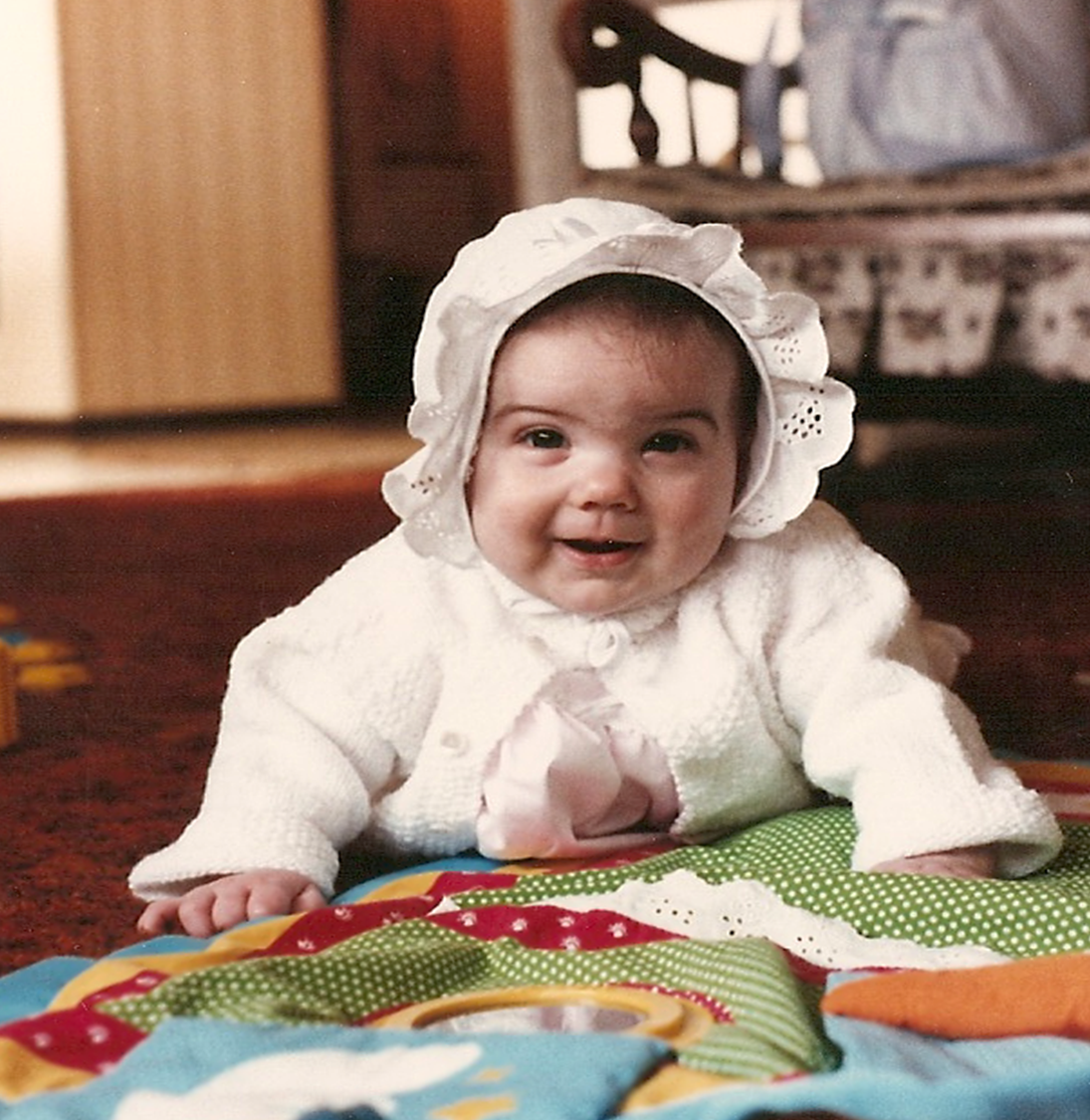
She was on the move…so our job in redirection and distraction had begun!
When we are holding our newborn, most of us can’t even wrap our mind around the idea that some day this precious child might need a little redirection or even a time out! But the days and weeks fly quickly, and you wake up one day to a 9 month old that is crawling and discovering and actually needs to learn the word “No”. Distraction and redirection are important tools in the discipline process for infants and young toddlers. Parents can often remove a child from a “No” and redirect to a better activity without too much difficulty. This takes practice, time, patience, consistency and a lot of chasing! Remember when you wished your baby would just move off that blanket? Well he does…so here we go!
Age 1-3 months
- During these first few months, your baby must learn that his parents are in love with him and will keep him fed, safe, and loved. At this age, parents need to respond quickly to an infant’s cry and not let a child “cry it out” at this age. An infant cannot be spoiled! You are teaching that the world is a great place and establishing a bond of trust in these first few months.
Age 4-8 months
- A baby’s cries will expand from hunger, fear and discomfort to include “I’m bored.” Parents will start to be able to tell the difference in their child’s cry…”I’m hungry” “I’m tired” and “I’m bored” When your baby cries for attention you now can wait a bit and call that you are coming in just a minute. A child can learn to entertain himself briefly and recognize that when he is bored play is more satisfying than food or crying.
8-12 months
- When babies become mobile, parents need to introduce the word “No.” It is best to child proof well and remove as many of the “No” things as possible. Children at this age are not capable of willfully disobeying, they are just curious. Behavior is very exploratory. Children roll and crawl and begin to toddle and explore their environment. By removing things that you do not want your child to touch, or dangerous items, then the number of “disciplinary” actions will greatly decrease. Hand slapping or spanking is not an effective method, the results are temporary and it is a confusing message to your child, distraction and redirection is best!
- Provide activities that interest your child. If your child is wanting to climb on the coffee table, then provide a safe way to climb. If your child wants to push the buttons on the TV, then find a toy that he or she is able to use the buttons on safely. Most behaviors are motivated by learning and curiosity at this age.
- Babies at this age are easily satisfied with another toy. Take the item that you do not want your child to have and trade it for an appropriate toy. If your child becomes upset, describe the feeling he has “I know you are upset because you wanted to push the buttons on the channel changer, try these buttons!”
- You cannot reason with a child at this age, so long explanations why something is dangerous or not an appropriate toy is wasted and actually reinforces the behavior. (Remember our mantra? Attention is attention whether negative or positive and attention reinforces the behavior) When your baby heads towards a dangerous activity or one that is not appropriate, say “No” in a firm voice and move your child to another area and redirect with another activity.
- If your baby throws a tantrum, go about your chores etc. in a very detached way giving no attention. Try to avoid saying no to everything annoying and save it for the important things.
- You must be consistent. If the TV remote is not a plaything one day–then it cannot be a plaything another day. This is confusing for a child. Dad, Mom and all caregivers must be on the same page!
- Babies at this age can learn that it is a benefit to cooperate. Many fight getting dressed or having a diaper changed. Your goal is to teach that cooperation is much more fun! Change the diaper on the floor now, most of the time your baby is trying to roll and it is difficult and dangerous on a changing table. Your baby fights the diaper change because it is a real interruption in his day! He was involved in play and doesn’t want to be restrained. Before you begin, talk to your baby. Engage your child with smiling and talking telling your child you are going to change a diaper. Give your child a toy, maybe one that you save only for diaper changes. When your baby tries to flip over, immediately stop talking, not a word—not even “NO.” Turn your baby over and change the diaper with as little fuss as possible. If your baby stops trying to flip over, begin to talk and smile and engage your baby again. Remove your attention if the flipping over starts again, don’t show any frustration and remember no talking! Once the diaper change is over start chatting and smiling again. After a few days of this most, babies try to engage their parent’s attention and learn that it is much more fun to cooperate with the diaper change! This technique can be used for other behaviors too.
Redirecting and distracting a baby
- When your baby is doing something that is dangerous or not appropriate, move your baby to another part of the room and redirect him to a safer activity or toy.
- Help your baby with the activity for about 30 to 45 seconds. This will help your baby become involved enough in the new activity that he will hopefully not return immediately to the undesired activity.
- If your baby immediately returns to the undesired activity, say “No” in a firm but not a scary voice and redirect again.
This redirecting and distracting may need to be done many times until your baby understands that certain things and/or activities are off-limits. Babies will then learn when Mom or Dad says “No” they need to redirect and won’t need your help in that quite as often. A baby that has had a hand slapped repeatedly will not learn how to redirect with the word “No” as easily. Hand slapping stops the behavior in the short run, but redirection and distraction teaches a child a strategy when a behavior is undesirable.
Discipline lessons in the first year.
- The world is a great place and I have loving parents.
- I can entertain myself for a short amount of time and wait for attention from Mom or Dad.
- When I cooperate, it is more fun!
- If I challenge Mom and Dad with a behavior that is not safe or undesirable, they react consistently and not in a scary manner.
- “No” means stop, and I am learning to find a new activity when I hear the word.
Distraction and redirection is an important discipline tool that works for toddlers too. Remember, consistency is so important and attention to positive behavior only is the key. We don’t have to be loud, scary, or use spanking or hand slapping to establish boundaries for our children. We need love, consistency, patience, a plan, a little creativity, a good night’s sleep and an occasional piece of chocolate 🙂 to provide the loving discipline every child needs.
More tips and techniques to come!
Take a breath, enjoy the joyful moments of each day, and remember you don’t have to be perfect to be the perfect parent.
Cindy
What is in your discipline “bag of tricks”?

What is in your discipline bag of tricks?
It was 7:30 am and my day was in full swing. I was chasing a two year old trying to get him dressed again. It is barely an hour into the day and I felt like I was on the verge of yelling and a time out before breakfast just didn’t seem right. Sound familiar? I am a big believer that spanking and yelling are not the best choices for discipline. I have taught 1,2,3 Magic for years….but sometimes you just need something else. Discipline is a parenting must. Children need guidelines, boundaries, expectations, consistency and consequences. I think parents really need a “bag of discipline tricks” to parent effectively. These “tricks” can help prevent physical punishment, increase cooperation, take away some of the No’s in your child’s life and quite honestly maybe bring a smile to you both. Here are a few “tricks” to keep in your repertoire….share a few of your own too!
This is my favorite discipline technique which is very effective when used consistently and according to the rules. Do not use it for everything….save it for behaviors you want to eliminate quickly.
- Remove your child from the conflict and give attention.
I know I always say that we should never give attention to a negative behavior, but if a child is acting inappropriately sometimes simply removing him from the conflict gently and bringing him to another activity of cooperation is effective. Example…You see your child grabbing toys from others and becoming aggressive, you walk up and take him by the hand and say “Come with me I need help getting snack ready.” You have just removed him from the behavior that is inappropriate, not used the word NO, and given positive attention for the cooperative activity. Usually works!
- Change your requests from “go” to “come”.
If you are trying to get your child to do something, approach from a cooperative view-point. Instead of “Go put your coat on.” Try “Come with me to put your coat on.” The tone totally changes and cooperation increases!
- Turn your no to a yes.
Telling a child “no” to a request will often result in a meltdown. When possible, change that “no” to “yes”. Example “I know you want to go outside, we can’t now but yes, we will after lunch.” “Let’s play with the water here in the sink, not the water in the dog’s bowl.” “Leave your shoes on now, we will take them off at home!”
- Try using the “not for” phrase.
“Hands are not for hitting they are for patting and loving.” “Trucks are not for throwing, they are for pushing.” “Food is not for throwing it is for eating.” Soon you may hear your child repeating those phrases to keep himself from the activity!
Nothing like a little humor to diffuse a situation! Try putting that jacket on your child’s leg, or hopping to bed, or singing a silly song. Once you both are smiling cooperation increases.
- Think Like A Toddler.
Why did your child just dump the dog food out again….or throw the ball in the house again…or dump a box of cereal out and stomp on them…??? Yelling “STOP WHAT ARE YOU DOING?” just doesn’t work. A young child doesn’t think about why he is dumping dog food or stomping on cereal, he is thinking this is so fun! When you think like a child you will have more patience and will react a little calmer. Tell your child that the activity looks like so much fun…redirect to something appropriate and have them help you clean up! (as much as a 2 or 3 year old can!)
- Behavior charts and rewards.
Time In is as important as Time Out. What does that mean? Reward your child throughout the day with positive words, stickers, hugs, stories or other positive reinforcements for behavior you like. That positive attention increases that behavior and then allows your child to really FEEL the removal of that positive attention if you give a Time Out for unacceptable behavior. Sticker charts work well at age 2 and older. Younger toddlers…and even older children will often just love a sticker to wear or a stamp on their hand for positive behaviors. If you have ever been to a Gymboree class you know how important that stamp on the hand is! Get creative! I heard of a Mom sending her child to bed with a brown bag every night. If he did not get up, there was something in it in the morning! Ignore unacceptable or annoying behavior when you can and reinforce the positive. Rewards should not always be bought…rewards of time make the most impact.
- Use consistent words to help your child.
“No touch”, “Kind words”, “Good choices”, “Gentle touch”, “Walking feet”….think of a few of your own. The more often your child hears the same consistent phrase, the more likely he will comply with the behavior. A reminder that results in cooperation is better than a punishment after the fact.
- Substitute appropriate behavior.
“Let’s climb on the couch cushions not on the table.” “Let’s throw the ball, not the truck.” “Let’s sing a loud song instead of scream.” Simply saying “no” without an alternative will often result in a meltdown or defiance. Give an alternative to the behavior you don’t want, and make it a similar activity to gain cooperation. Often your child is working on a skill like climbing or throwing!
- Try playing a game to get your child to cooperate.
“Let’s play a pretend game when you get dressed. It is all pretend, but if you do what I say you will get to wear a sticker! Are you ready? OK, Connor let’s pretend….Put your shirt on please.” If he does it you respond, “Wow I can’t believe you could put your shirt on! Are you sure you haven’t played this game before?” Give a big hug and a sticker. Because it is a “game” your little one will be excited about trying it out. Soon it will become merely cooperation.
- Intervene early.
You know your child and their behavior. If you see the unacceptable behavior beginning….redirect early. Don’t let the hit, bite, or shove actually happen. As your child becomes aggressive step in and redirect.
- Be assertive but also a cheer leader.
Don’t be wishy-washy and ask “Would you want to pick up the toys?” or “I am thinking it might be time to pick up and leave.” Be assertive and tell your child what is going to happen so there is no question on who is in charge, then be cheerful and firm on what will happen next. Cheer your child on as they begin to cooperate. Giving the impression that there is a choice or a chance to negotiate when there isn’t always results in conflict.
- Redirect physically.
A child may need to be physically moved from an area to redirect. Sometimes your words will not work. A child who is becoming aggressive should be carried or walked to another activity quickly.
- Praise ten times more than you correct.
Yep, you heard me correctly. Praise effort and not outcome and praise a lot. That is what a Time In is. Time Out removes your attention….the rest of the day should be a Time IN. Time Outs will not work if your child doesn’t feel the difference of the removal of your attention.
- Calm Down Bottles.
Another tool to help your child learn to “flip the switch” to calm down on his own. That is the skill we want all of our children to develop!
- Have an older child determine his or her punishment.
An older preschooler, school age children and teens are very good at deciding what the consequence for their unacceptable behavior should be. Often they are tougher on themselves than you would be. The consequences they decide usually make sense and are remembered.
- Start over….over and over again.
Rewind. This was one of my favorite tools. If your child is just starting off on the wrong foot, or you see a behavior that is inappropriate and can be fixed immediately; simply turn your child in a circle and make a “rewind” sound and let your child try again. I love the second chance to make things right. Sometimes my husband will actually do this to me in the morning if I am grumpy before that morning coffee kicks in!
So, those are a few tricks to put in that discipline bag. Be sure you are taking care of yourself, because we all know that we aren’t able to tap into our patience or discipline approach if we are on empty ourselves. You and your child deserve parents who “fill themselves up” so they are at their best. As time goes on, you will find the discipline approaches that work the best for each of your children. No child’s day should be filled with more “no” than “yes”, more boundary setting than free play, or more tears than smiles. We all will have bad days, but the good moments should outnumber the difficult. Remember, the purpose of boundary setting and discipline is to teach….not to upset your child.
Take a breath, enjoy the joyful moments of each day, and remember you don’t have to be perfect to be the perfect parent.
Cindy
Add a little silliness to your discipline…it works!
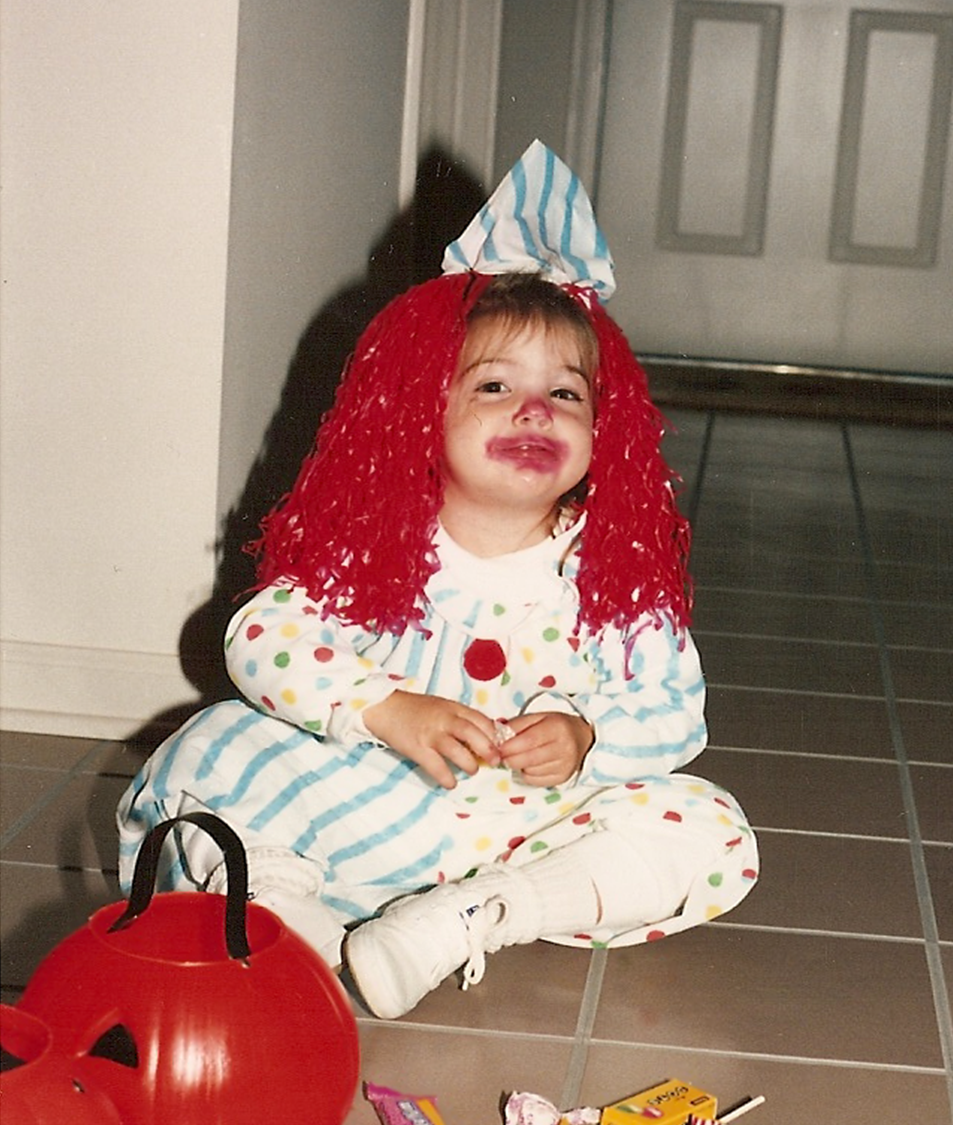
A little “clowning around” with discipline will work! Infuse a little silliness in your day! 🙂
All the discipline discussion over the last few days and I feel like a very serious parent! Discipline is serious business, and a very real necessity for your child, but there certainly are moments that a little bit of silliness or humor will diffuse a situation and result in your child not needing that time out! Potential conflict can be diffused with a little bit of fun. Humor can catch your child off guard and prevent a power struggle from even beginning.
1. Use a funny voice.
Asking your child to pick up toys or do a chore that he has refused to do in a silly voice may just be enough to get him laughing and cooperate!
2. Use physical humor.
Distraction with something that looks funny may just lighten the mood enough to encourage cooperation. Your child doesn’t want to get dressed? What would happen if you pretended to put on your child’s shirt? What if you tried to put the arms of your child’s shirt on your child’s feet? This little bit of silliness may be enough to get your child to forget about the battle and cooperate. Sometimes using physical humor that is totally unexpected will diffuse a situation. If you have a child who is melting down, put something silly on your head, make a funny face, do something goofy….you might see a little laugh through the tears and the situation is diffused.
3. Use games.
Play games for cooperation. Racing the clock to complete a request is a great game to encourage cooperation, but you can even be more creative. Having trouble with your child holding your hand in a parking lot? Try asking your child to “lead” you to the car because you “forgot” what your car looks like…walk up to the wrong car and pretend to get in and see the giggles start. Each time you need to hold hands, start the game. Think of a game to try in those situations that you know your child has difficulty cooperating. Try it before the conflict begins, it may even become your own special game that just the two of you share!
4. Rewind
Give your child a 2nd chance every once in a while. If your child says “no” to a request, “rewind”. Be silly and back up physically and rewind your voice…try the request again. My husband was always very good at this….he would take our kids’ shoulders, turn them in a circle….and start over. This usually brought a smile and a better choice to cooperate from our kids.
5. Use a silly question.
If you get a defiant “No” from your child…try a silly question. “Hmmm you don’t want to wear your coat? What about wearing your bathing suit today?” Sometimes a ridiculous suggestion or question results in cooperation!
Remember to use humor at the right moment. There are times to be serious and follow through with your discipline plan, a firm “No” and a time out. At no time should you use humor to belittle your child….but there certainly are times that a little fun and games can diffuse a stressful situation, increase your child’s cooperation, and let’s face it…make the day a bit more fun for both you and your child! Increase your silliness today and see what happens.
Take a breath, enjoy the joyful moments of each day, and remember you don’t have to be perfect to be the perfect parent.
Cindy
Don’t work so hard…summer fun is easy!
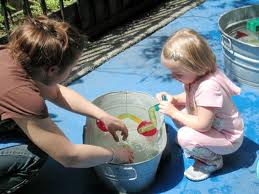
Keep it simple…fun and learning can happen as easily as a bucket with water and a few ice cubes!
I was talking to my daughter the other evening after she had been babysitting some children of a wonderful Mom from one of my Mom’s groups I lead. She showed me pictures of the toddlers entertaining themselves with a tray of ice cubes. What a great way to spend the afternoon! I often want to tell Moms…”Don’t work so hard at it!” In other words, kids can be entertained and actually learn valuable concepts by simple activities. It often does not take a lot of money or expensive toys or classes to fill a morning or afternoon with fun and kids always learn with fun!
It is summer and water is one of the best entertainers. A baby pool filled with a couple of inches of water, a water table, or a large under bed plastic storage container filled with a few inches of water will entertain for long periods of time.
- Dump ice cubes in the water and let the kids try to scoop them up or catch them. Let them watch the ice melt.
- Add measuring cups, spoons, pitchers, sieves and other kitchen items. Let the children fill things up, pour and dump.
- Add a little bubble bath and let them use an egg beater to make bubbles.
- Take a bucket of water and add paint brushes and paint rollers. Let them “paint” the sidewalk, patio, deck, or brick house. My son “painted” our house for hours.
- Get the tricycles, wagons, or even your car out. Let the kids play car wash!
- What floats and what does not? Let your child figure it out!
- Pretend play with cups, spoons, and bowls…what will they “cook” with the water?
- Throw a package of new sponges in the mix. Can they fill up a new bucket by squeezing the sponges full of water?
- Add dishes and a dish cloth. Let them pretend to “wash” the dishes!
- Give a baby doll a bath.
- Have small trucks and cars out to wash or make bridges to get over the water.
Besides all of this fun…what has your child accomplished?
- Fine motor skills and eye hand coordination through pouring, squeezing, stirring, painting and scrubbing
- Math concepts of more/less, empty/full, greater than/less than
- Imaginative and creative play when playing car wash, painting, and cooking
- Verbal skills talking about what they are doing
So, relax, it is summer! Don’t work so hard Mom and Dad, keep it simple and fun. Take a child, add some supervision, and who knew a little water and ice could entertain and teach so much!
Take a breath, enjoy the joyful moments of each day, and remember you don’t have to be perfect to be the perfect parent.
Cindy

Oh what a difference a year makes! Growth and Development milestones the first year.

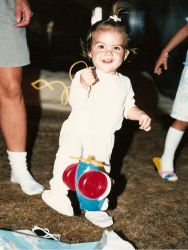
From one day to one year, what a difference a year makes!
The first few months of my children’s lives sometimes felt like a blur. Parents get VERY little sleep and are just trying to get to know their baby. I can remember feeling that the first year just flew by and all of a sudden I would have a toddler on my hands! There are so many changes that come so quickly with your baby that first year!
During that first year, your baby is learning that he or she will be loved and cared for. It is important to foster that development of trust. Don’t let your baby cry for long periods of time, especially in the first 6 months. Crying is your baby’s way of communicating. Soon you will learn what different cries mean, like “I’m tired”, “I’m hungry”, “I’m wet”, “I need to be held”, “I am bored”….Responding to your baby’s needs helps your little one develop trust in you and the world. You cannot spoil a baby! Older children can be spoiled, but not infants, so just enjoy catering to their needs and loving your baby.
Growth and development should be steady and progressive. That is more important than comparisons with other children. It is common for new parents to look at other babies and start to worry and compare. Try not to compare, just know what important milestones your baby should be reaching. Recently the CDC and American Academy of Pediatrics revised the developmental milestones for children. Prior to this, the milestones were set for when about 50% of children would reach the milestone. Often this resulted in a “wait and see” attitude. The new milestones are set when 75% or the majority of children have reached the milestone. This resulted in some of the milestones pushed back just a bit, but also results in a referral when a child misses the milestone instead of a “wait and see” attitude. The CDC has an app for your phone and detailed lists of the current milestones that can be accessed on the website.
How big your baby is at birth is a poor predictor about the size of your child by adulthood. The size at birth has more to do with the conditions of uterine development. Most children will find their growth curve and stay at that curve. A child that is smaller than 75 percent of other babies his or her age can be perfectly healthy, that may just be the growth curve that child has. By the end of the 2nd year, the size of your child will more truly reflect his or her adult size.
We parents know that our children are special! However, reaching developmental milestones faster than other children does not necessarily predict your child’s intelligence. As long as your child is reaching his or her developmental milestones on target, there are no worries!
By the end of the 2nd month your baby should:
- Smile
- Look at you!
- Start to try to self soothe. May bring hands to mouth and suck
- Begin to smile at people
- Start to coo
- Turn towards sounds
- Follow things with eyes
- Pay attention to faces
- Hold up head and begin to push up during tummy time
Activities for parents:
- Talk to your baby
- Show simple objects
- Give your baby different looks at the world, change his or her scenery!
- Play the silly face game, open and close your eyes, stick out your tongue etc.
- Start the routine of a daily walk weather permitting
- Help baby with tracking objects, babies love mobiles, shapes and movements
- Imitate your baby’s sounds and expressions as your baby starts to learn to communicate
Your baby’s growth:
- Growth will be about an ounce per day in the first 2 months
- Growth will continue at about a pound a month after the first couple of months
- Birth weight doubles by 5 months
- Birth weight triples by one year
By the end of the 4th month your baby should:
- Like to play and interact with you!
- Copy some movements and even facial expressions like smiling
- Babble even with expression
- Cry in different ways for different needs like hunger, or being tired, or lonely
- Reach for a toy or rattle
- Track with eyes well side to side
- Be able to roll from tummy to back
- Push up on elbows during tummy time
- Like colors now and be drawn to them
Parent activities:
- Continue to talk, talk, talk
- Build reading into your daily routine
- Respond to your baby’s coos and babbles…carry on a conversation!
- Continue to show your baby the world!
By the end of the 6th month your baby should:
- Recognize a familiar face and begin to have some stranger anxiety
- Like to look at self in the mirror
- Use vowel sounds when babbling and takes turns in a “conversation” with you!
- Begin some consonant sounds when babbling
- Respond when you say his or her name
- Transfer things from hand to hand, easy to hold toys are important
- Try to get things that are out of reach
- Roll from tummy to back
- Sit with support
- Like to “stand” with you holding and might bounce
- Start to push up and may rock back and forth on hands and knees
- Start to scoot and move arms like a swimmer
- Sometimes show frustration if he can’t reach something he wants
- Teething may begin with the average baby cutting their first tooth by the end of the 6th month
- Should start the “dropping game” between 7 and 8 months (helps your baby learn object permanence)
- Should begin clapping between 7 and 8 months
Parent activities:
- Remember stranger anxiety starts at about 6 months and peaks at about 9 months. This is normal. Help your baby by gradually introducing strangers. A stranger is someone your baby does not see everyday! Never force a situation quickly when your baby is afraid of a new face. Hold your baby, sit on the floor and let your baby explore with you holding him or staying near at first.
- Start to teach finger games like “so big”, waving “bye-bye”, playing patty cake
- Continue to read and talk to your baby
- Make sure you are establishing routines, especially bed time and nap time routines
By the end of the 9th month your baby should:
- Begin to have favorite toys
- Understand the word “no”
- Copy sounds you make and gestures you make
- Begin raking small objects to pick them up
- Play peak a boo
- Look for hidden items
- Look where you point
- Sit well without support
- Gets to a sitting position on his/her own
- Lift arms to be picked up
Parent activities:
- Continue to play finger games like “Itsy Bitsy Spider”
- Continue waving bye-bye
- Build things for baby to crawl under and over
- Let your baby play with every day objects like pots, pans, plastic containers
- Encourage your baby to imitate your behavior like brushing hair, talking on the phone
- Encourage pretend play with keys, phones, dolls, chunky trucks etc.
- Play with pop up toys, a jack-in-the-box is a great way to teach object permanence
- Play in and out games
- Let your baby hold your fingers to walk
By the end of the 12th month your baby should:
- Waves bye-bye
- Understands the word “no” may briefly stop when he/she hears the word
- Puts items into a container
- Pull up to stand
- Cruise around furniture
- Drinks from an open cup with you holding the cup
- Uses thumb and forefinger to pick up small items (pincer grasp)
- Plays games with you like Patty Cake or So Big
- Look for missing objects in last seen location
- Say Ma Ma and Da Da
- Start to show fear, will cry when you leave
Parent activities:
- Help baby with push toys, wide based push toys that children can walk behind are fun!
- Play games that the baby has a part in like puffing up your cheeks and letting her push the air out
- Look at books and make up stories about the pictures
- Teach body parts Where is your nose? Where is your tummy?
- Play with musical instruments that shake and bang
- Play music your baby loves to move and dance
Take a breath, enjoy the joyful moments of each day, and remember you don’t have to be perfect to be the perfect parent.
Cindy
Helpful websites:
Let’s talk toddler!
Kaitlyn was a typical toddler, she definitely had an opinion!
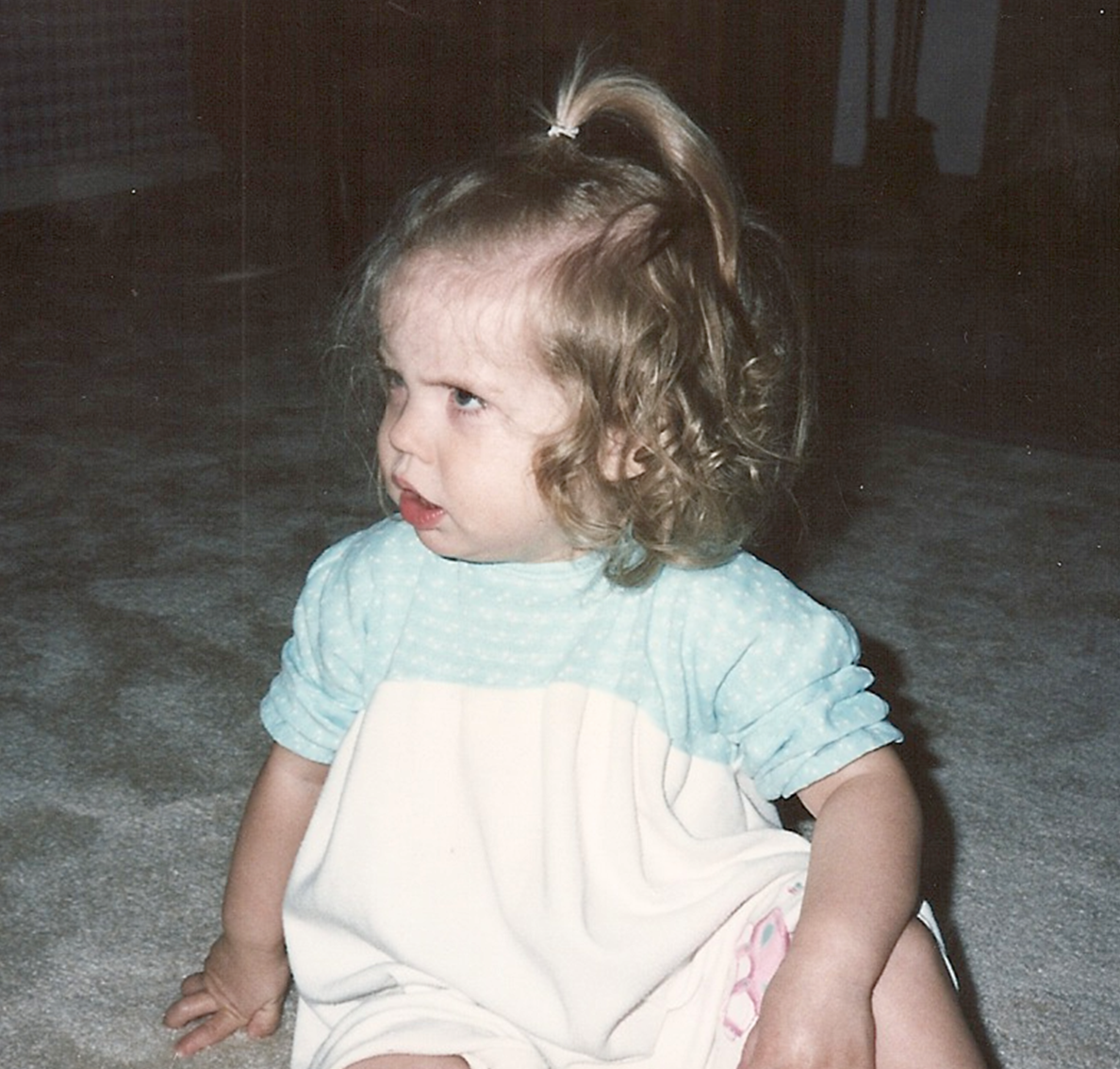

You wake up one day, and it is a whole new ball game. You now have a toddler. Toddlers are so much fun, but can also be a challenge. We are not used to our child having an opinion, and a toddler has one and often expresses it very loudly! Toddlers can be having a tantrum one minute and laughing the next!
Your toddler’s biggest developmental task is to start to develop independence. Your child will begin to separate from you at times, and be very clingy at other times. Every day and sometimes every minute, is a new adventure when you have a 1 to 3 year old!
Recently the CDC and American Academy of Pediatrics updated the growth and developmental milestones for toddlers. They moved the milestone back to when 75% of the children should reach it. In the past, the milestones were set when 50% of the children were reaching it. This change will hopefully remove the “wait and see” attitude and encourage parents and health care providers to refer when a milestone is not reached. There is an excellent app for your phone and easy to read milestone lists for each age group on the CDC website.
We know that toddlers are a bundle of energy. Everything is an adventure! Kitchen cupboards, knobs and buttons, computers, and even the drain in the tub is interesting. Toddlers are busy discovering and really don’t have time for naps and potty training, although both are important for toddlers! Toddlers are free little spirits and have very little self-control, which often results in your precious child throwing himself on the floor in a fit of frustration and anger. To better understand your toddler, there are a few principles of toddler psychology…..
- A toddler is developing creativity, independence, curiosity, and imagination. The whole world is open and exciting! Your child is not misbehaving when he smashes peas, climbs on the table, or puts his finger in a place it should not be, he is exploring. Exploration is developmentally appropriate for your toddler!
- A toddler has very little self-control and tolerance to frustration. Sometimes it is so frustrating that a puzzle piece will not fit, or he can’t climb on the counter, or you break up his cracker that he wanted whole! Because a toddler has very few words and a limited repertoire to handle frustration, the “logical” thing for him to do is melt down, kick, cry, and let his opinion be heard by all!
- Toddlers want attention. Attention is attention to a toddler, whether it is negative attention or positive attention. As parents, we need to limit our words of explanation to a toddler. A 2-year-old doesn’t really care if he will fall off the table, he just wants to climb on it. You will never convince him otherwise…there will be no moment of epiphany when he understands your safety talk! We must not reinforce behavior by giving extended attention to unwanted behavior. Give lots of positive words to positive behavior….very few words to negative behavior.
- Toddlers need predictability and routine. Your child will behave much better when there is a routine in place at home. The amount of frustration and the number of tantrums will decrease when you establish routines and rituals.
- Toddlers need some sense of control. Give your child true choices. “Do you want the bananas or the apple sauce?” “Do you want to wear this shirt or this one?” “Do you want to read your story before your bath or after?” Do not give choices when there are no true choice. Only ask a yes or no question if you are happy with the answer being “No!”
- Toddler temper tantrums are a result of frustration, being overly tired, being hungry and learning that they work!
Most 1 year olds can:
Social/Emotional Milestones
- Plays games with you, like pat-a-cake
Language/Communication Milestones
- Waves “bye-bye”
- Calls a parent “mama” or “dada” or another special name
- Understands “no” (pauses briefly or stops when you say it)
Cognitive Milestones (learning, thinking, problem-solving)
- Puts something in a container, like a block in a cup
- Looks for things he sees you hide, like a toy under a blanket
Movement/Physical Development Milestones
- Pulls up to stand
- Walks, holding on to furniture
- Drinks from a cup without a lid, as you hold it
- Picks things up between thumb and pointer finger, like small bits of food
- 1 year olds should have tripled his/her birth weight
- Take 1 to 2 naps a day and sleep 11 to 12 hours at night. Be sure to have a good bedtime routine.
Most 15 month olds can:
Social/Emotional Milestones
- Copies other children while playing, like taking toys out of a container when another child does
- Shows you an object she likes
- Claps when excited
- Hugs stuffed doll or other toy
- Shows you affection (hugs, cuddles, or kisses you)
Language/Communication Milestones
- Tries to say one or two words besides “mama” or “dada,” like “ba” for ball or “da” for dog
- Looks at a familiar object when you name it
- Follows directions given with both a gesture and words. For example, he gives you a toy when you hold out your hand and say, “Give me the toy.”
- Points to ask for something or to get help
Cognitive Milestones (learning, thinking, problem-solving)
- Tries to use things the right way, like a phone, cup, or book
- Stacks at least two small objects, like blocks
Movement/Physical Development Milestones
- Takes a few steps on his own
- Uses fingers to feed herself/himself some food
- 15 month olds will often take 1 nap a day and sleep 11 to 12 hours at night.
- Not separate easily. Separation anxiety peaks between 18 and 24 months.
- Know the difference between how Mom and Dad parent and play. Many will prefer one parent over the other at times. Toddlers cannot intentionally do things to hurt your feelings at this age. Connecting with one parent over the other may be because your toddler is learning male and female roles, may need more nurturing from mom or more physical play from dad. Roll with it!
Most 18 month olds can:
Social/Emotional Milestones
- Moves away from you, but looks to make sure you are close by
- Points to show you something interesting
- Puts hands out for you to wash them
- Looks at a few pages in a book with you
- Helps you dress him by pushing arm through sleeve or lifting up foot
Language/Communication Milestones
- Tries to say three or more words besides “mama” or “dada”
- Follows one-step directions without any gestures, like giving you the toy when you say, “Give it to me.”
Cognitive Milestones (learning, thinking, problem-solving)
- Copies you doing chores, like sweeping with a broom
- Plays with toys in a simple way, like pushing a toy car
Movement/Physical Development Milestones
- Walks without holding on to anyone or anything
- Scribbles
- Drinks from a cup without a lid and may spill sometimes
- Feeds herself with her fingers
- Tries to use a spoon
- Climbs on and off a couch or chair without help
- Toddlers at this age will start to develop separation anxiety. Always tell your child when you are leaving, never sneak out. Tell them you will return and they are safe.
Most 24 month olds can:
-
Social/Emotional Milestones
- Notices when others are hurt or upset, like pausing or looking sad when someone is crying
- Looks at your face to see how to react in a new situation
Language/Communication Milestones
- Points to things in a book when you ask, like “Where is the bear?”
- Says at least two words together, like “More milk.”
- Points to at least two body parts when you ask him to show you
- Uses more gestures than just waving and pointing, like blowing a kiss or nodding yes
Cognitive Milestones (learning, thinking, problem-solving)
- Holds something in one hand while using the other hand; for example, holding a container and taking the lid off
- Tries to use switches, knobs, or buttons on a toy
- Plays with more than one toy at the same time, like putting toy food on a toy plate
Movement/Physical Development Milestones
- Kicks a ball
- Runs
- Walks (not climbs) up a few stairs with or without help
- Eats with a spoon
Most 2 1/2 year olds can:
Social/Emotional Milestones
- Plays next to other children and sometimes plays with them
- Shows you what she can do by saying, “Look at me!”
- Follows simple routines when told, like helping to pick up toys when you say, “It’s clean-up time.”
Language/Communication Milestones
- Says about 50 words
- Says two or more words together, with one action word, like “Doggie run”
- Names things in a book when you point and ask, “What is this?”
- Says words like “I,” “me,” or “we”
Cognitive Milestones (learning, thinking, problem-solving)
- Uses things to pretend, like feeding a block to a doll as if it were food
- Shows simple problem-solving skills, like standing on a small stool to reach something
- Follows two-step instructions like “Put the toy down and close the door.”
- Shows he knows at least one color, like pointing to a red crayon when you ask, “Which one is red?”
Movement/Physical Development Milestones
- Uses hands to twist things, like turning doorknobs or unscrewing lids
- Takes some clothes off by himself, like loose pants or an open jacket
- Jumps off the ground with both feet
- Turns book pages, one at a time, when you read to her/him
Most 3 year olds can:
Social/Emotional Milestones
- Calms down within 10 minutes after you leave her, like at a childcare drop off
- Notices other children and joins them to play
Language/Communication Milestones
- Talks with you in conversation using at least two back-and-forth exchanges
- Asks “who,” “what,” “where,” or “why” questions, like “Where is mommy/daddy?”
- Says what action is happening in a picture or book when asked, like “running,” “eating,” or “playing”
- Says first name, when asked
- Talks well enough for others to understand, most of the time
Cognitive Milestones (learning, thinking, problem-solving)
- Draws a circle, when you show him how
- Avoids touching hot objects, like a stove, when you warn her
Movement/Physical Development Milestones
- Strings items together, like large beads or macaroni
- Puts on some clothes by himself, like loose pants or a jacket
- Uses a fork
Parenting activities for toddlers include:
- Toddler “field trips”. Bring your toddler to museums, parks, library story times, the post office, the grocery store, fire stations, apple orchards, and play groups.
- Play matching games, sorting games, shape and color games and puzzles.
- Read, read, read! Try to read 30 minutes a day broken into short time slots.
- Encourage crayons, finger paints, and clay to develop fine muscle control for writing. Writing on an easel or blackboard is easier for young children because larger muscles are used.
- Encourage water play, sand or dry rice play, filling and dumping.
- Play with puppets.
- Allow your child to feed himself, encourage use of utensils.
- Help to expand your toddler’s language by talking to him. Help him finish words and sentences. If he says “cup”, you can respond, “You want your blue cup with milk.”
- Play pretend with your toddler. Play kitchens, dolls, stuffed animals, trains, cars, dress up….
- Play follow the leader with your toddler.
- Encourage rhymes and songs.
- Play musical instruments with your toddler.
- Respond to wanted behaviors with positive words and ignore unwanted behaviors. Use time outs for behaviors like hitting, biting, and shoving.
At your child’s 18 month and 24 month well child visit, your healthcare provider should be screening for signs of autism. Red flags that a parent might see are:
- Your child repeats words but does not try to participate in conversations.
- Your child does not respond to his name when you say it.
- Your child does not make eye contact with you or others.
- Your child avoids social contact or physical touch.
- Your child has not developed speech or is losing words rather than building a vocabulary.
- Your child does not play with toys like his peers and does not use imaginative play.
- Your child seems to be under sensitive or overly sensitive to stimulations such as sound, touch, and texture.
Remember, if your child is reaching developmental milestones, no worries! Many times children will not be able to do something that is expected because they have never been encouraged or have never had the opportunity. Be sure to provide the opportunity for your toddler to reach milestones, even if it takes longer to allow your child to complete a task, or it is messy!! If your child is not reaching developmental milestones, contact your doctor, and refer to your state’s early intervention program. The earlier the intervention, the better the outcome.
Important links that will help you:
- “Learn the Signs. Act Early.” Campaign
This campaign educates parents about childhood development, including early warning signs of autism and other developmental disorders, and it encourages developmental screening and intervention. It will give you tips on how to determine if your child needs screening. - Overview of Early Intervention
Learn more about early intervention services from the National Dissemination Center for Children with Disabilities. Find out about your state’s early intervention program and how to access it. - Bright Futures

Bright Futures materials for families are available for parenting tips for children from birth to 21 years of age. This is provided by the American Academy of Pediatrics. - Developmental Surveillance and Screening Guidelines
This American Academy of Pediatrics website provides guidelines on surveillance and screening for developmental delays in children. - National Association for the Education of Young Children (NAEYC)
NAEYC provides accreditation for early childhood programs and preschools that meet certain standards. You can search for an accredited program or preschool near you. NAEYC also provides resources, tools, and information for parents.
Toddlers can be exhausting, but exhilarating! Looking through your toddler’s eyes, you will learn to enjoy the small wonders of the world again. Tie up your running shoes, you have a busy toddler!
Take a breath, enjoy the joyful moments of each day, and remember you don’t have to be perfect to be the perfect parent.
Cindy
Protecting your child from bug bites

Protection from ticks and mosquitoes is important for your child!
Today is beautiful, and I hope most of you have your children outside at some point! Children both love and NEED to be outdoors. Outside activity is an important part of a healthy child’s life, and it helps children get good and tired too! I know one of the biggest reasons I encouraged outdoor play was that it provided me with a good long nap from my children in the afternoon. A method to my parenting madness!
With spring and summer upon us, the pesky bugs will soon be too! Not only are these insects just plain annoying, they can carry dangerous diseases to your children. Most children have mild reactions to bug bites, but some children (are they just sweeter?) really seem to attract those insects and those bites result in large red welts that make them miserable. West Nile Virus, Lyme Disease, and Rocky Mountain Spotted Fever, and the recent outbreak of Zika Virus are diseases that could result from insect bites too. So, if we want our children outside and we don’t have a protective “bee suit” in the house…what are we to do?
The use of insect repellents are recommended by the American Academy of Pediatrics and the Center for Disease Control. Although most of us hate to put chemicals on our children, DEET used correctly is one of the best protectors for your child. The amount of DEET in insect repellents varies from less than 10% to more than 30%. Studies show us that the higher concentrations of DEET protect for longer periods of time, but not more effectively. So a repellant with 10% DEET will protect for about 2 hours, 24% about 5 hours, and at over 30% there is very little increase in protection. The AAP recommends using a concentration of DEET between 10 and 30 percent. Most of our children will not be outside in an area with biting insects more than 2 hours at a time…so 10% DEET should be enough the majority of the time.
How to use insect repellent safely:
- Always read the label.
- Do not use DEET on children under 2 months of age.
- Do not use a concentration of DEET greater than 30%, usually 10% will be adequate.
- Only apply the repellent to the outside of your child’s clothing and on exposed skin.
- Use a small amount just to cover the area, thicker layers are not more effective.
- Do not spray repellents on your child’s face. Put the repellent on your hands and rub on your child’s face being careful around eyes, and mouth.
- Do not put repellent on your child’s hands. Do not apply to open areas like cuts.
- Spray repellents in open areas, do not breathe them in.
- Wash your child with soap and water to remove the repellent when he comes inside. Wash your child’s clothes before he wears them again.
- Do not use sunscreen/insect repellent combinations. You will need to reapply the sunscreen and the repellent should not be reapplied.
- Cover your child’s exposed skin with long pants and sleeves if you know he will be in an area with a lot of biting insects. This will decrease the skin area that will need repellent.
- Try to avoid dusk, the “buggiest” time of day!
- Remember DEET is NOT effective on stinging insects like bees and wasps.
Repellents that do NOT work
- Wristbands with chemical repellents
- Dryer sheets pinned to your children (A big trend a few years ago! I once saw an entire preschool class of children on a playground all equipped with dryer sheets!)
- Garlic (would keep other people away! )
- Ultrasonic devices that give off sound waves
- Bug zappers (may actually increase insects in the area)
Other repellents:
- Permethrin is a chemical repellent. It is effective and should be applied to clothing only, or items like tents, not on skin. Use in concentrations of between 5 and 10 percent. This repellent will kill ticks on contact. Great for spraying on tents and sleeping bags.
- Picaridin is as effective as DEET and some studies show it may be less likely to cause skin irritation in children. It has been used in Europe for many years, more recently here in the U. S.
- 2% soy bean oil and lemon eucalyptus has been shown recently to be as effective as 10% DEET. Lemon Eucalyptus Oil is not approved for use in children under the age of 3.
- Cedar, and Citronella essential oils are less effective and give very short term protection.
So the bottom line is, insect repellents are a better alternative that the potential complications from a disease carrying insect. Be smart and use repellents safely. Protect your child with clothing and by avoiding the time of day/night and areas where insect bites would be more common. Check your child for ticks daily and remove any tick with a tweezers and clean with soap and water. Lastly, put this at the bottom of your worry list….outdoor fun is essential for children! Protect them with common sense and enjoy the outdoors…don’t let the bugs scare you off!
Take a breath, enjoy the joyful moments of each day, and remember you don’t have to be perfect to be the perfect parent.
Cindy
Reference: www.healthychildren.org
Summer…what will you do?

Summer!
Well, Memorial Day Weekend is just around the corner, and the first week of “summer” is quickly approaching. There is just something about summer, a feeling of relaxation and freedom. Even with grown children I look forward to the last day of school and the anticipation of long summer evenings and less rush in our life. I guess summer is really a mind set. Well, it is time to enter the “summer mindset” and enjoy. Summer is fleeting, the moments move quickly, and before we know it the fireflies are gone replaced by fall colors. So start that summer bucket list…what will you and your child do to build memories of the LONG summers of childhood; the kind that seemed to be lazy and filled with true summer fun. Here are some suggestions for your summer bucket list, I know these are on mine!
- A trip to the beach. Any beach! Something about sand and summer. Be sure to bring sand toys and a full afternoon.
- Berry picking. Berries are in season all summer. Strawberries now, then black raspberries, red raspberries and blueberries. Nothing better than a berry straight from the vine and then a shortcake or cobbler that evening for dessert.
- Evening bike rides. After the heat of the day, a cool evening ride down the Monon Trail is such a wonderful end to a day. Of course, it is even better when we stop for ice cream before we head home. Best when I can convince my husband it is not a competition!
- Free summer concerts. I love to head to the summer concerts that are offered all over the area. Pack up the kids, a few snacks and a blanket and head out to a little music under the stars. Kids love to twirl and dance to the music and what a wonderful way to introduce all the different music varieties to your children, for free! Try going kidless too…what a great date night!
- Baseball. What is summer without it? Take in a game and don’t forget the peanuts and popcorn. Victory Field offers wonderful grassy seats on the hill!
- A trip to the farm. For this city slicker, a trip to the local dairy farm is always a treat. Take a tour of Trader’s Point Creamery, enjoy the beauty of the area and sample some ice cream, or just take a drive outside the city through farm country. Stop at roadside farm stands and sample the taste of summer.
- Hit the local drive-in root beer stand. I think this is a memory from my childhood that just screams summer. I can remember the excitement of having the tray hooked to our car window and the “baby” mugs of root beer being delivered right to the car. Healthy eating?? Not so much. Great memories?…absolutely. Memories win in this case.
- Lunch time picnics. No work, no real planning, no mess…just PB&J and relaxation on a blanket. A little running or rolling down a grassy hill and great naps after!
- Fireflies. Summer brings the magic of fireflies. Even the youngest child and oldest adult can be mesmerized by looking at a backyard “light up” with flashes of magical light. Be sure to stay up past your child’s bedtime for the show…at least once.
- Popsicles. Cold, juicy and dripping down your arm…pure summer.
So that is the start of a Summer Bucket List…simple right? Just sit for a moment and think about the days ahead. Don’t let the summer days slip by without experiencing the lazy, hazy days. No pressure, just experience it. Give your child the memories of LONG summers…even though the moments go quickly. Share your list!
Take a breath, enjoy the joyful moments of each day, and remember you don’t have to be perfect to be the perfect parent.
Cindy
Sunshine, summer, and sunscreen!
Sunshine certainly is good for our soul, but we know it can also cause a painful sunburn. Use of sunscreen should be added to your “to do” list before your child heads out the door to play. This past weekend I strolled through the aisle of sunscreen and realized there are simply too many choices! A quick check of a sunscreen’s label will make the choice much simpler. So….what is the best choice for your child? Here are the most important things to remember:
- Children under 6 months of age should be protected from the sun as much as possible. This means shading your child with umbrellas, awnings, trees, and protective clothing. When you cannot protect your child from the sun…then use sunscreen where needed. All labels will say not recommended for children under 6 months of age, but you must use sunscreen if you cannot effectively shade your child.
- SPF protective clothing is wonderful! Rash guard shirts, swim suits, and hats are available at relatively inexpensive price points. Clothing that is SPF protective is easier than applying sunscreen to those areas!
- Choose sunscreen that states it is “broad spectrum”. That means it protects against UVA and UVB rays.
- Choose a sunscreen that has an SPF of at least 30.
- There is NO waterproof sunscreen, only water resistant. The label will tell you if it is 40 minutes or 80 minutes of water resistance. ALL sunscreen needs to be reapplied after leaving the water and towel drying no matter how long your child has been in the water.
- The best choice for sunscreen has zinc oxide or titanium oxide as the active ingredient. These are mineral based sunscreens and not a chemical based sunscreen. This mineral based sunscreen is gentler on your child’s skin and there are some studies that chemicals like oxybenzone can affect normal hormone levels in children. Zinc oxide and titanium oxide are ingredients in most diaper rash creams and are very safe!
- If you have no other option than a chemical based sunscreen then use it! No sunscreen is more dangerous than using the chemical based sunscreen.
- Choose a lotion over a spray. I know sprays are convenient, but often the coverage is poor (try spraying a wiggling toddler!) and inhaling the spray may irritate a child’s airway.
- Use enough sunscreen! Adults should use about an ounce of sunscreen (think the amount of a shot glass) and a child needs approximately half of that or enough sunscreen to fill the palm of your child’s hand. If that 8 oz tube of sunscreen has lasted you more than 3 weeks, you aren’t applying enough!
- Re-apply at least every two hours, more often if your child has been in the water, sweating, or you have towel dried them.
- The most expensive sunscreen may not be the best sunscreen! READ the label…pure and simple. Very few ingredients are needed, zinc oxide or titanium dioxide is the most important ingredient on the label.
Summer fun in the sun is a must for children….and so is protection of their skin when in the sun. During childhood, children usually receive about 25% of their lifetime sun exposure. Unprotected sun exposure as a child can result in skin cancers later, so protection from sunburn is essential. So, stock up on safe, effective sunscreen for your family and enjoy the summer sun!
Take a breath, enjoy the joyful moments of each day, and remember you don’t have to be perfect to be the perfect parent.
Cindy
 raisingkidswithlove